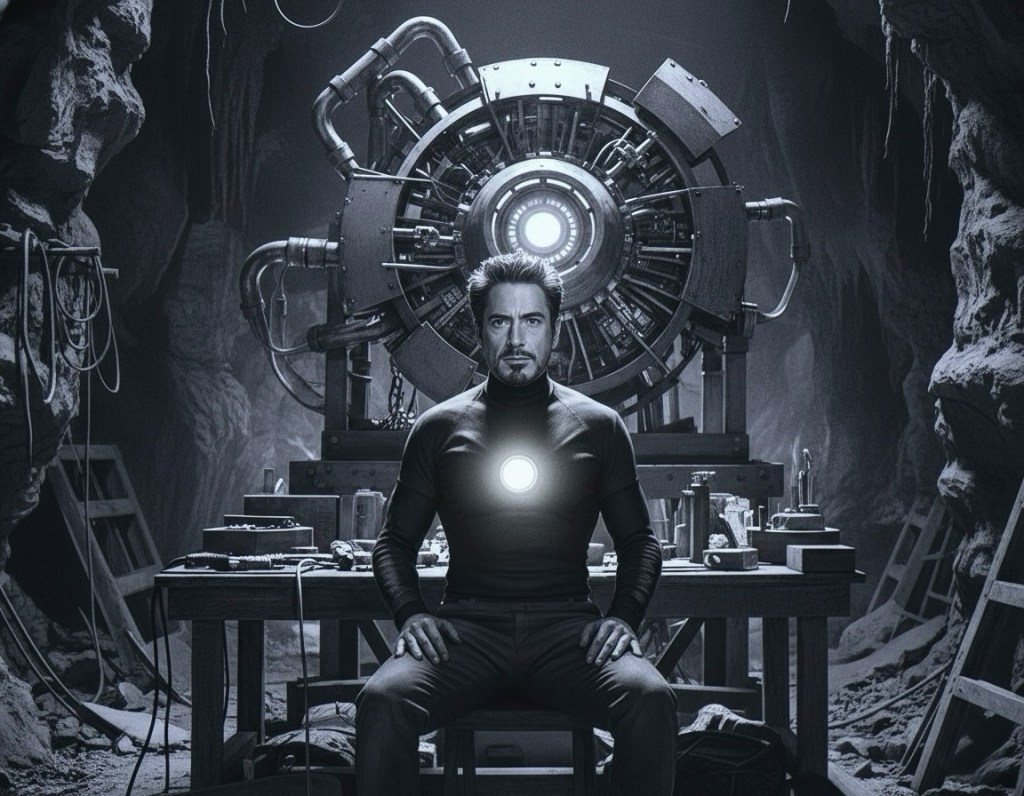
This morning I rewatched Iron Man. Tony Stark, trapped in a cave, builds a palm‑sized reactor out of scrap metal. Unlimited energy, right there in his chest. He saves himself, then the world. I paused the screen and thought: why can’t we do that? Why, in 2025, are we still paying electricity bills, still arguing about energy crises, still failing to stop climate change?
The easy answer is: because it’s just a movie. But the truth is more complicated. The “arc reactor” isn’t pure fantasy. It’s a dramatized version of something real: nuclear fusion. The same process that powers the sun. Science fiction, yes—but also science not yet achieved.
Take ITER, the vast international fusion project in southern France. Work began in the 1980s; today, 35 countries are involved. The price tag has ballooned to tens of billions of dollars. And the latest official timeline? First meaningful operations in 2035. Half a century of effort, and still no electricity on the grid. Tony Stark did it in three days with a box of scraps.
Or look at the U.S. National Ignition Facility. In December 2022, they announced a historic milestone: for the first time, a fusion experiment produced more energy than the lasers delivered to the fuel pellet. The headlines screamed “fusion breakthrough.” But the fine print was sobering. The lasers themselves consumed hundreds of megajoules of electricity; only a fraction reached the plasma. The net system efficiency was closer to 1%. A commercial plant needs to be 300–400%. The gap is staggering.
MIT’s SPARC project is more compact, aiming for net energy by the late 2020s. But even SPARC will be the size of a building, not something you can slip into your chest. And the challenges remain brutal: plasma hotter than the sun, materials that crack under neutron bombardment, tritium fuel that barely exists in nature. Every solution spawns three new problems.
Fusion has been “thirty years away” since the 1950s. In the 1970s, they promised it by 2000. In the 1990s, by 2020. Now the target is 2050. It’s become a running joke. But the joke hides a truth: fusion is the hardest engineering problem humanity has ever attempted. Dreaming is easy. Building is hard.
And yet, I can’t dismiss it. Because the physics is sound. A few grams of deuterium and tritium could power a city. The fuel is in seawater. The waste is far less dangerous than fission. One gram of fusion fuel could equal the energy of tons of coal or oil. If we can tame it, fusion could change everything.
But not tomorrow. The realistic timeline looks like this:
2030s: experimental reactors like ITER and SPARC achieve net energy, but not commercial power.
2050s: the first commercial fusion plants, each the size of a football stadium, producing hundreds of megawatts.
2070s and beyond: maybe costs fall, maybe fusion spreads. But the palm‑sized arc reactor? Still fantasy.
And the obstacles are not just technical. Economics matter. Recent cost analyses suggest that even if fusion works, the first plants could cost tens of billions to build, with electricity prices higher than renewables or fission in the early decades. Integrated cost models published in 2025 show that unless materials, efficiency, and tritium breeding improve dramatically, fusion may remain a boutique technology rather than a mass solution. Investors are pouring billions into startups, but the question remains: can fusion ever be cheap enough to compete?
Plasma control is another frontier. Magnetic confinement requires superconducting magnets cooled to near absolute zero, while the plasma itself burns at over 100 million degrees. The contrast is absurd: colder than space, hotter than stars, separated by a few centimeters of steel. Researchers describe plasma as “trying to hold jelly with rubber bands.” It writhes, twists, and escapes. Every second of stability is a victory.
Materials science is equally daunting. Neutrons from fusion reactions slam into reactor walls with 14 MeV of energy, displacing atoms, creating cracks, and turning steel brittle. Studies from Purdue and Peking University show that even advanced tungsten alloys degrade within a few years. Self‑healing materials and graphene coatings are being tested, but nothing is ready for decades of continuous operation.
And then there’s the tritium problem. Deuterium is abundant in seawater, but tritium is rare and radioactive. Current global production is only about 20 kilograms per year, mostly from heavy‑water fission reactors. A single commercial fusion plant would need hundreds of kilograms annually. The solution is “tritium breeding”: using lithium blankets around the plasma to generate tritium from neutron bombardment. The physics works on paper. In practice, it’s never been demonstrated at scale. Without it, fusion is impossible.
So no, Tony Stark’s arc reactor won’t be real in our lifetimes. Plasma can’t be miniaturized, tritium can’t be carried in your chest, neutron radiation would kill you in hours. But the dream matters. In the 1960s, Star Trek’s communicators were fantasy. Today, we all carry smartphones. Maybe in a century, our grandchildren will laugh at how we once thought fusion was impossible.
The lesson is simple: dreaming is easier than achieving. But without the dream, achievement never begins.
Here’s what I looked at while researching:
Wazeer, A. et al. (2024). Neutron Irradiation Damage in Tungsten and Alloys, Metals
ITER Organization (2024). Revised Timeline: Initial Operations in 2035
National Ignition Facility (LLNL, 2022). Fusion Ignition Milestone
MIT/CFS (2024). SPARC Tokamak Overview
IAEA (2025). Fusion Energy in 2025: Six Global Trends to Watch
Fusion Industry Association (2025). Global Fusion Investment Report
Chapman, R. (2025). Developing Integrated Cost Models for Fusion Power Plants, Journal of Fusion Energy
IntechOpen (2025). Plasma Confinement and Nuclear Fusion
Princeton Plasma Physics Lab (2023). Fusion Fuel Cycle and Blanket
 THINKLINIC
4 responses to “Arc Reactor: Why Can’t Tony Stark’s Dream in His Chest Become Reality?”
Your essay successfully transforms a metaphor from popular culture (Iron Man’s “arc reactor”) into a rigorous discussion of the current state of nuclear fusion research. By referencing projects such as ITER, NIF, and SPARC, you provide a concrete framework that highlights both the immense promise and the formidable challenges of fusion energy. This comparative approach allows readers to grasp not only the scientific realities but also the long-term perspective required for such an undertaking.
The phrase “dreaming is easy, building is hard” encapsulates the essence of scientific progress with remarkable precision. Your work manages to balance optimism about fusion’s potential with a sober recognition of its technical and economic limitations. This equilibrium makes the essay both informative and thought‑provoking. It is a valuable contribution to a website that aims to combine accessibility with intellectual depth.
LikeLike
This piece is fascinating in the way it bridges science fiction and real-world science. The comparison between Tony Stark’s arc reactor and nuclear fusion makes the subject approachable for readers who might not otherwise engage with such technical material. What I particularly appreciate is the reminder that imagination precedes innovation—without bold dreams, progress stalls. The essay leaves me hopeful that, even if fusion takes decades, the pursuit itself will inspire breakthroughs across science and engineering.
LikeLike
Your essay provides a clear and structured overview of the current state of fusion research. By outlining ITER’s timeline, NIF’s milestone, and SPARC’s ambitions, you give readers a realistic sense of both the progress and the obstacles. The emphasis on plasma control, materials science, and tritium breeding reflects the complexity of the challenge. It is refreshing to see a discussion that neither exaggerates nor dismisses fusion, but situates it within a sober long-term perspective.
LikeLike
While the essay is engaging, I find its optimism somewhat overstated. Fusion has been “thirty years away” for over half a century, and the economic realities are often glossed over. Even if ITER or SPARC achieve net energy, the projected costs and scalability issues suggest fusion may remain a niche technology rather than a global solution. The comparison to smartphones or Star Trek communicators feels misleading—fusion is not just a matter of time, but of unprecedented technical and financial hurdles. A more critical stance on whether fusion can truly compete with renewables would strengthen the argument
LikeLike