I was born in 2007. I never lived through Chernobyl, never watched Fukushima unfold with the awareness of an adult. When the tsunami hit Japan in 2011, I was only four years old. The images must have been on television, but I don’t remember them. For my generation, nuclear disasters are not lived experiences but inherited memories — fragments from documentaries, black‑and‑white footage of abandoned towns, the eerie silence of Geiger counters. Nuclear energy, for us, is a story told by others.
But I did grow up with another story, one that was far less abstract. I grew up in the center of Zonguldak, but from time to time we would go to Çatalağzı. There, within a strip of land barely one and a half kilometers wide, stood three thermal power plants with seven units in total. The horizon was always gray, and people often spoke about cancer cases. My mother worked as a doctor for the Turkish Hard Coal Enterprises, and I sometimes visited her at the mines. I saw the black dust on the workers’ faces, the dangerous conditions underground, the toll coal took on human lungs. That was not a documentary. That was part of my childhood landscape.
And so I find it strange when people tell me nuclear energy is “too dangerous.” We already live with dangers we barely question. Coal has killed silently for decades. Natural gas, which heats so many homes today, carries the risk of leaks and explosions. Yet these risks are normalized, while nuclear — with far fewer deaths, far stricter safety protocols, and far greater potential to cut emissions — is treated as an untouchable monster. Isn’t that a contradiction worth confronting?
Globally, nuclear energy provides about ten percent of the world’s electricity, according to the International Energy Agency. In France, the figure is closer to two‑thirds. Paris runs on uranium. Meanwhile, Germany, after Fukushima, shut down its reactors and turned back to coal. The same technology, two opposite decisions. What does that tell us? That nuclear energy is not just about physics or engineering. It is about memory, culture, and trust.
And yet the future is pressing in on us. The climate crisis is no longer a distant threat; it is the air we breathe, the heatwaves we endure, the floods that wash away entire towns. Fossil fuels are suffocating the planet. Renewables are essential, but they are not always reliable. The sun does not always shine, the wind does not always blow. When they falter, we need a backbone — a steady, carbon‑free source of power. Nuclear is the only candidate that can play that role at scale.
The technology is evolving. Small Modular Reactors promise faster construction, lower costs, and greater flexibility. Fourth‑generation designs aim to recycle nuclear waste, turning yesterday’s problem into tomorrow’s fuel. International studies, from the OECD‑NEA to the Congressional Research Service, converge on the same point: reaching net‑zero by 2050 without nuclear is nearly impossible. The question is not whether nuclear should be part of the future, but whether we are willing to overcome the ghosts of the past to let it be.
Of course, nuclear energy is not risk‑free. Accidents have happened, and they could happen again. Waste must be stored safely for centuries. Construction is expensive and slow. But compare those risks to the certainty of climate collapse if we continue to rely on coal, oil, and gas. Compare them to the silent suffering of miners in Zonguldak, or the invisible particles from thermal plants that lodge in children’s lungs. Which danger is truly greater? Which danger is more honest?
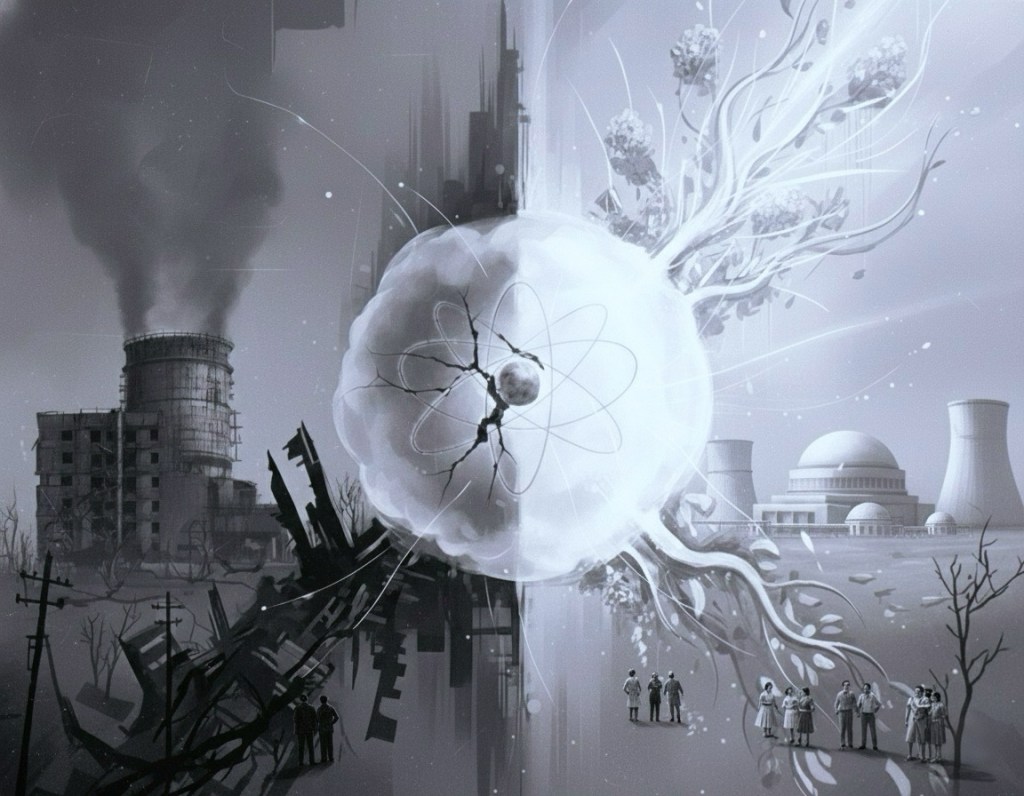
For me, nuclear energy is not an abstract debate. It is a contrast I have lived: the choking smoke of thermal plants versus the promise of clean, steady power. It is the memory of my mother working among coal miners, contrasted with the vision of a future where no one has to descend into dangerous shafts just to keep the lights on.
So when I hear people dismiss nuclear energy as “the past,” I cannot help but think: perhaps it is coal and gas that are the relics, the real ruins of yesterday. Nuclear, with all its flaws, may be the only bridge strong enough to carry us into tomorrow.
The real choice is not between safety and danger, but between different kinds of risks. One risk is familiar, normalized, and deadly. The other is feared, dramatized, but far more manageable with modern science. Which one should we choose?
I believe the answer is clear. Nuclear energy is not the haunted ruin of the past. It is the unfinished promise of the future. And the sooner we stop running from it, the sooner we can start building a world that is not only powered, but sustained.
Here’s what I looked at while researching:
HEAL (2020). Chronic Coal Pollution in Turkey: Health Impacts of Çatalağzı Thermal Power Plants.
International Energy Agency (IEA). Nuclear Power and Secure Energy Transitions.
World Bank. Electricity production from nuclear sources (% of total).
OECD-NEA (2021). The Role of Nuclear Energy in Mitigating Climate Change.
UNSCEAR (2022). Sources and Effects of Ionizing Radiation.
Congressional Research Service (2025). Nuclear Energy and Climate Change Mitigation.
 THINKLINIC